
The Origin of Locks - Yanmen Security Door
A lock is not merely an everyday article of human life, but also a cultural (folk-custom) object, representing the culture of a nation and its people across different historical periods. The history of locks in China stretches back thousands of years, born almost simultaneously with private property. In the beginning, people simply wrapped their valuables in animal hide, bound them tightly with rope, and finally tied a special knot at the opening. This tightly bound knot could only be undone with a tool called a "cuo". Also known as a "xiao", a "dao" or a "qizi", it was made from animal tooth or bone, shaped like a sickle-like hook. In fact, the knot was the earliest form of a lock, and the "cuo" was the earliest key—this is the embryonic form of locks in China. This type of lock was used from the Shang dynasty through the Han dynasty, then was later made of jade and evolved into an ornament worn on the clothing of the nobility. The simplest lock applied to doors was the wooden door bolt. In ancient China there were stone locks without keys, secured with rope or iron chains. During the Yangshao Culture some 5,000 years ago, our ancestors created wooden locks mounted on timber-framed buildings (see the Encyclopedia of China · Light Industry Volume). This is the oldest lock in the world, worthy of being called the "world's first lock". This wooden lock has been passed down among the people ever since—for instance, the white-wood locks of the Ming dynasty were once used on buildings in the Zhejiang region. Similar wooden locks can still be found today in Yi ethnic mountain villages around Kunming. During the Shang and Zhou period, as private ownership of the means of production further developed and the gap between rich and poor widened, social conflicts became acute. At the same time, smelting technology matured and was immediately applied to the lock-making industry, giving rise to bronze and iron locks that could only be opened with a key, with different keys matched to different locks. By the Eastern Han, China's iron three-spring lock technology had reached a fairly high level, and the three-spring lock remained in use for over 1,000 years.
In Europe, it was not until the second half of the 19th century that locks became widespread and entered private homes. Before that, locks were expensive and remained out of reach for ordinary people, serving as a symbol of wealth and power. In Japan, when people mentioned locks in the past, they thought of the strongbox locks that were the exclusive possessions of the rich. In the early 18th century, the British inventor D. Potter invented the cam-disc tumbler lock. Its key variations grew from the 20-odd types of the three-spring lock to more than 80. In the mid-19th century, European manufacturers modified the cam-disc tumbler lock and three-spring lock into the sliding-disc tumbler lock, whose key variations could reach 1,600 types. In 1848, the American inventor Yale invented the pin-tumbler lock using cylindrical pin stacks, which has become the most widely used lock in the world. The structure of the modern pin-tumbler lock has further evolved, with the emergence of two-, three- and four-way pin configurations, as well as flat, double-sided, multi-sided, double-row double-sided, multi-row multi-sided and combined pin structures, greatly enhancing the lock's security and increasing its key variations from the original 2,500 to millions through changes in "direction" and "face".
With advances in science and technology, mechanical locks have also made considerable progress. Modern mechanical locks have a history of over a hundred years; pins of varying lengths were added inside the cylinder, to be opened by a correspondingly toothed key. In the 1970s, with the application of microelectronics, there appeared magnetic locks, voice-activated locks, ultrasonic locks, infrared locks, electromagnetic-wave locks, electronic card locks, fingerprint locks, retinal locks, remote-control locks, and so on. These locks offer a level of security unmatched by purely mechanical structures. Modern locks can also, within specific systems, achieve programmatic control following preset logical relationships. Modern locks can be classified by material, use, presence of a key, security performance, and structure.
Today, locks have formed a very large family, and they are constantly being improved and upgraded, continuously showing the world their wonders. In short, locks perform the function of "binding and restraining" in human civilized society, regulating social behavior, safeguarding people's lives and property, and maintaining social stability.
Lock Classification
Ancient locks were first called mu, bi, yao, lian, and ling. Early ones were of bamboo and wood structure, originating from door fixtures. By the Spring and Autumn and Warring States period, Lu Ban installed hidden mechanisms inside wooden locks; by the Eastern Han, metal spring-plate structure locks (also called groove locks) were made. In the Tang, locks were mostly of gold, silver, copper, iron, and wood. By the Ming, they had developed into four major categories: broad locks, floral locks, jewelry locks, and restraint locks. In fact, there was also a type of combination lock, just less common. Through the Qing, the Republic of China, and up to the 1950s, the craftsmanship of ancient locks was exquisite and profound, rich in cultural meaning. Carved patterns and inscriptions included: "Top Graduate in the Imperial Exam", "Longevity and Wealth", "Qilin Bringing a Son", "Dragon and Phoenix Bringing Auspiciousness", and so on. Taking the fish-shaped lock as an example, the Zhitian Record states: "Door locks must be fish-shaped, taking from the fish's vigilance in keeping watch at night." The fish also signifies the auspicious wish for "abundance year after year." Ancient locks also symbolized wealth, hence the saying "the donkey carries the keys, the horse bears the lock." Later it extended to eternal love, family continuity, and lifelong health—it seems all good wishes were bestowed within.
According to records, the earliest wooden locks were so fragile they could only serve as symbolic locks. China's metal locks first appeared in the Han dynasty, of the spring-plate structure. The Ming and Qing eras were the heyday of ancient locks, mainly of copper and iron. In the 1950s, low-cost low-welded hook locks, leaf locks, and pin-tumbler locks entered the Chinese market one after another, and China's ancient locks thus exited the stage of history. Through these ancient locks, weathered by time, one appreciates the profound and vast Chinese history and culture. Specific names of locks include one-open locks, two-open locks, three-clap locks, three-ring shrimp-tail locks, four-open locks, five-open locks, dragon-phoenix locks, dual-element locks, maze locks (directional locks), bottom-open locks, rotary-impact locks, reverse-pull locks, hidden-door locks, keyless locks, square locks, firecracker locks, horse-rein locks, ox-horn locks, ox-tail locks, lift-beam locks, character-combination locks, numeric-combination locks, and so on. Particularly worth mentioning is that, although these ancient locks varied in length and size, their external appearance was much the same; the mystery lay in the keyhole slots, which were truly varied and bizarre. The shapes of the keyholes were divided into characters such as "one," "up," "work," "ancient," "esteem," "auspicious," "joy," and "longevity". These keyholes also reflected the strict hierarchical system of ancient society! Commoners could only use the "one"-shaped keyhole lock; scholar-officials used the "scholar" and "auspicious" keyhole locks; for birthdays and festive occasions, "longevity" and "joy" keyhole locks were used; generals, ministers, and emperors had further distinctions and were not allowed to overstep, otherwise it was deemed a violation of royal law. By material, there are wooden locks, gold locks, silver locks, copper locks, iron locks, cloisonné locks, etc. By form, there are round locks, square locks, pillow locks, character locks, figure locks, animal locks, combination locks, hidden-door locks, reverse-pull locks, cannon locks, etc. By use, there are padlocks, door locks, chest locks, cabinet locks, box locks, drawer locks, warehouse locks, etc. In terms of craftsmanship and molding/casting classification, since the Ming dynasty locks have been divided into four major categories: broad locks, floral locks, jewelry locks, and restraint locks. The so-called "broad lock" means a horizontal lock. This type of lock was produced in abundance in Shaoxing, Zhejiang, and was also known as the "Shao lock". Among the people it was called the "horizontal-open lock", the "pillow lock", and so on. Since the Tang dynasty, broad locks have been widely used on doors, chests, cabinets, and cupboards, with over a hundred varieties. Broad locks are generally divided by size into eight specifications, measured in liang (taels); there are the "four-liang Shao", the "six-liang Shao", the "twelve-liang Shao", and so on. The "six-liang Shao" is about 3.5 cun long, and the "twelve-liang Shao" is about 7 cun long.
The classification of modern locks typically includes the following:
I. By Use
Common locks can be roughly divided by use into household locks, vehicle locks, safe locks, and special-purpose locks.
Household Locks
These include anti-theft door locks, padlocks, drawer locks (cabinet locks), bathroom locks, and other everyday household locks.
Vehicle Locks
These include various automotive locks, but with the development of modern automotive anti-theft systems,
automotive chip keys and other electronic anti-theft technologies have emerged.
Although not strictly locks, they, together with vehicle mechanical locks, serve as components of automotive anti-theft systems and have gradually become a new subject in the lock-repair industry.
Safes
A safe usually has two parts: a mechanical lock and a combination lock. The principle of a safe's mechanical lock is roughly the same as that of household locks, only differing in models and types; combination locks are further divided into mechanical and electronic types.
Special-Purpose Locks include aircraft locks, train locks, vehicle locks, marine locks, prison locks, and other dedicated locks used in special industries. By structure, locks can be roughly divided by the lock body structure into pin-tumbler locks, disc-tumbler locks, leaf locks, magnetic locks, combination locks, inductive locks, electromagnetic locks, biometric locks, and so on.
Pin-Tumbler Locks, also called pin locks, have a cylinder structure with upper and lower pins, the cylinder using varying numbers of pins as the blocking elements. Common cross locks, tubular locks, and single-groove locks are all pin-tumbler locks. These are mostly seen in households. Widely used, they offer poor anti-theft performance due to their simple structure.
Disc-Tumbler Locks are those whose cylinder structure uses spring plates as the blocking elements, with varying numbers of plates. Most common vehicle locks—such as inner-groove-key vehicle locks, outer-groove-key vehicle locks, and flat vehicle locks—as well as household drawer locks (cabinet locks), belong to this type. These are mostly used in vehicles and are structurally more complex than pin-tumbler locks.
Leaf Locks are those whose cylinder is composed of varying numbers of leaves, mostly found in financial locks; they are characterized by a relatively complex structure and good anti-theft performance.
Magnetic Locks operate on the principle that like magnetic poles repel and opposite poles attract to achieve locking and unlocking. The keyholes of such locks are mostly cylindrical or straight-plate in shape.
Combination Locks are opened by password and are mainly used in high-security locks such as safes.
Inductive (IC Card) Locks: these are further divided into contact IC card locks and contactless IC card locks. Contact types require inserting the card
into the lock slot to bring the chip's internal reader into contact; contactless types skip this step and only need the card brought close to the lock's reader. Inductive locks are widely used in public places such as parking lots and subways. Electromagnetic locks are made using electromagnetic principles, with electromagnetic force reaching several hundred kilograms; in the locked state, an ordinary person cannot pull them open at all. Their fatal flaw is that they cannot close the door during a power outage, so they are generally used on staffed passage doors, and for room doors they must be used together with a mechanical lock. Biometric locks emerged with the development of biometric technology, including advanced locks such as fingerprint locks, palm-print locks, and retinal locks.
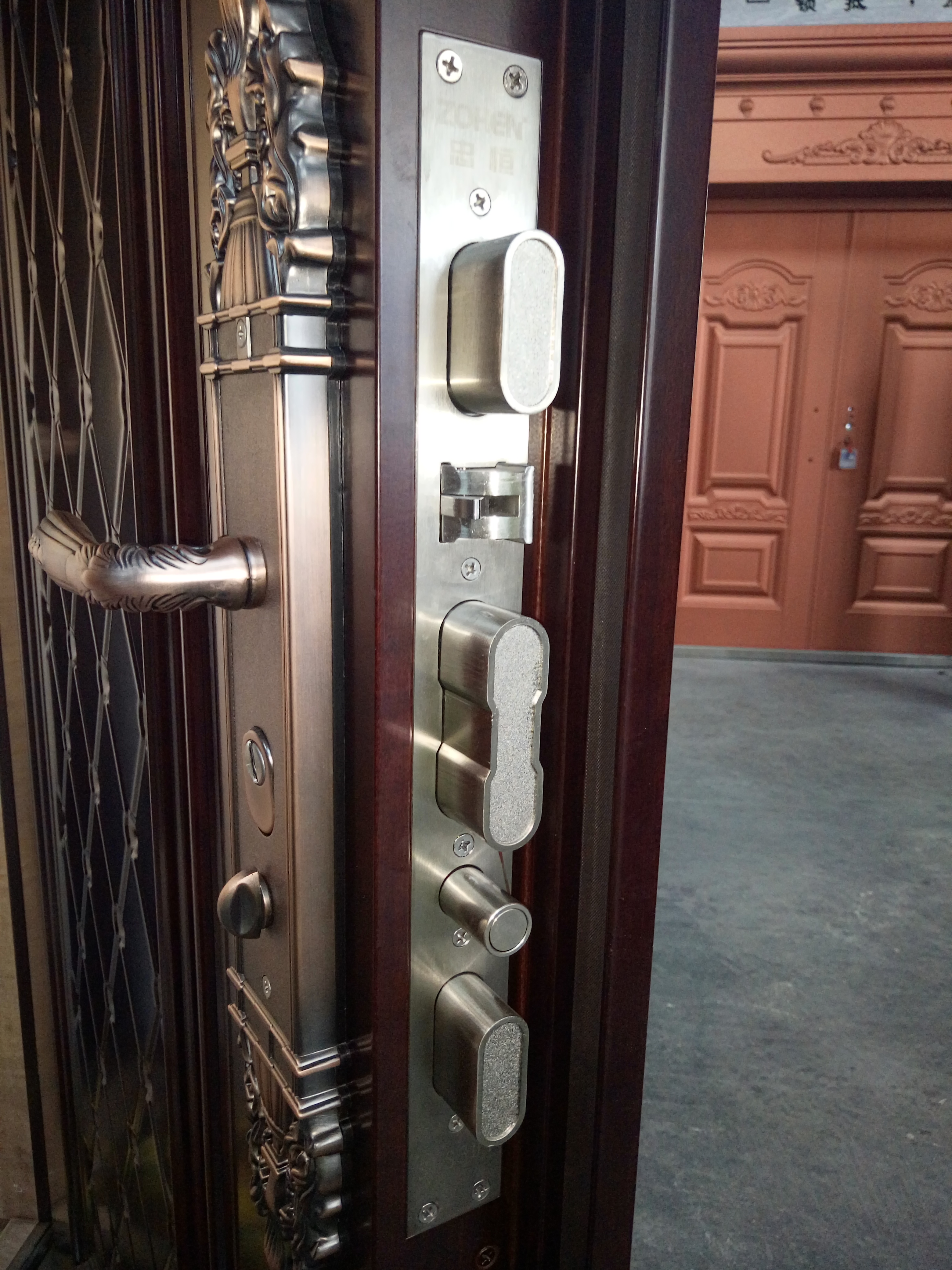
To meet people's higher anti-theft needs, modern locks have become more precise in structure and more complex in principle, and advanced locks with multiple interacting structures have emerged.
National Lock Standards:
System configuration, performance characteristics, applicable scope, and reference prices (due to different testing methods, the cycle/durability counts between American, European, and Chinese standards are not comparable).
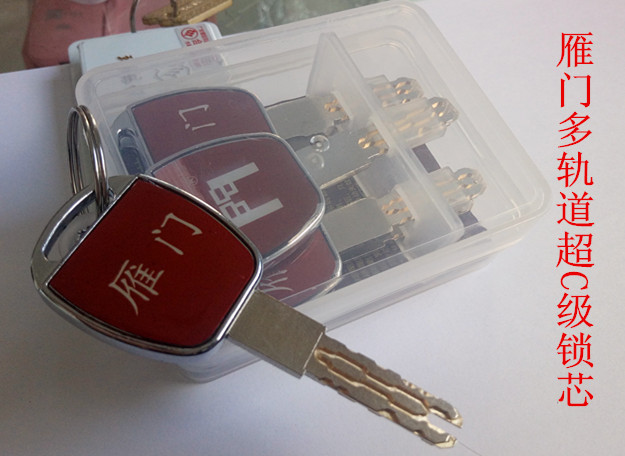
Lock Production, Assembly Process, and Coding:
(1) Production process: raw material shearing → stamping with various dies using an inclinable press → edge trimming → sand blasting → polishing → electroplating and sealing → assembly → inspection → packaging.
(2) Assembly process: parts and installation of a ball lock: front ball → cylinder → front spindle → ball cover → support bracket (including flange, slide plate, support frame, decorative sleeve) → front cover plate → switch cylinder → slider → spring → stop plate → rear spindle safety pin → inner core sleeve → rear cover plate → rear ball.
(3) Finish codes: SS — stainless steel satin; SP — stainless steel polish; SN — stainless steel cleaned; SBV — red copper satin; PBV — red copper polish; SB — brass satin; PB — brass polish; BP — iron plated imitation gold; AC — antique red; BN — black nickel; NK — iron plated bright nickel.
Notes on Choosing a Door Lock:
(1) Choose a brand with quality assurance. Because branded manufacturers have after-sales service stations everywhere, offering free on-site repairs during the warranty period.
(2) Door thickness: 35–50 mm suits ball locks; 35–55 mm suits mortise locks; core locks at the corresponding mm; 35–55 mm suits pin-tumbler locks.
(3) Backset: the door lock should be chosen according to the door structure; the latch can be 60 mm or 70 mm. For a door stile width above 100 mm, use the 70 mm latch; for widths below 100 mm but above 90 mm, choose the 60 mm latch.
(4) Pay attention to buying a lock whose handing matches your door's opening direction, because lever locks come in left- and right-handed versions.
(5) When choosing lever locks, try to keep the lever shape consistent across all functional locks to make the rooms more harmonious.
(6) Hinges: pay attention to choosing hinges of sufficient strength, to avoid the door sagging over time, which would affect the lock's operation and could even cause damage.
The above classification is the author's simple categorization of current domestic locks and covers the types with the largest market share; some less common locks will be discussed in later chapters.
Opening of Locks:
The relationship between lock-making and lock-picking is like the contest between the "spear" and the "shield".
The contest between lock-making and lock-picking has never stopped; people rack their brains, and over decades of struggle, the lock as the "shield" has for the most part never gained the upper hand. The contest between lock makers and lock pickers—"where the Tao is one foot high, the devil is ten feet high"—this battle of wits has lasted decades, beginning in the 1950s, when the door's "iron general" was the padlock, and a lock picker needed only a small piece of wire to open it with ease. Yet at that time few people bothered with such mischief, for the customs were simple and honest; indeed many villages left their doors unlatched at night, and even today in villages in Shanxi and elsewhere there are still many households with walls barely half a meter high and yard gates that are mere fences without locks.
By the 1970s, concealed locks began to be embedded in the doors of countless homes. But soon, lock pickers invented a small hook; once this hook was inserted into the keyhole and given a couple of gentle wiggles, the lock opened. This "technique" was quickly mastered by many, and even ordinary folks could easily open their own doors with their ID card. Lock makers had no choice but to find ways to "subdue the demons." In the 1980s and 1990s, cross locks appeared and anti-theft doors emerged accordingly; everyone thought they could finally "close the door and rest easy," but little did they expect the lock pickers to have leveled up as well. Their lock-picking tools numbered in the hundreds or thousands; a dedicated decoding device was only palm-sized, hooks of every shape were available, and what was even more amazing was that some could open a lock with chewing gum.
As the "contest" keeps escalating, some lock factories add rare metals inside the cylinder specifically to counter chewing gum and master keys, and additionally install irregularly shaped pins to guard against wire-hook picking. Some adopt single-groove key shapes and use computer-input passwords to prevent unauthorized duplication, but it wasn't long before rumors spread that the lock pickers were working their magic again.
Today, some lock manufacturers have made no progress in the anti-theft performance of their locks; for commercial purposes they only manipulate the lock's appearance, change the key shape, and create mystery to deceive consumers—the anti-theft performance of these locks is even worse than the oldest, simplest padlock. From the perspective of lock development history, to prevent master-key opening, the manufacturing process must be especially complex and the production cost increases tenfold or more, while its resistance to forced destruction is greatly reduced—an issue that has long troubled the lock-making industry. To this day, what kind of lock truly provides security is what consumers care about most.
A lock is not only an everyday necessity of people's lives but also a symbol of wisdom. The ancients invented locks to guard their wealth, and modern locks are even more the guardians of people's safety. The history of locks is long, and lock culture is but one of the countless dazzling sprays in the five-thousand-year-long river of Chinese history and culture.
How may we assist you?
We are ready to assist you at any time.

- Copyright:Zhejiang Longchuan Industry & Trade Co., Ltd.
- 浙ICP备12001761号-4 浙公网安备33072302100126号